Bolsonaro: The Messias has arrived, but there is no salvation.
Last October, Jair Messias Bolsonaro, labelled by international social media as ‘the tropical Trump’, was elected in Brazil with 55% of votes. What does this election mean for the world, and why all Brazilian environmentalists are so worried?
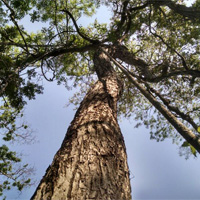
The Songs of Trees
We’re all — trees, humans, insects, birds, bacteria — pluralities. Life is embodied network. These living networks are not places of omnibenevolent Oneness. Instead, they are where ecological and evolutionary tensions between cooperation and conflict are negotiated and resolved. These struggles often result not in the evolution of stronger, more disconnected selves but in the dissolution of the self into relationship.
Brazil: The Land of the Future?
It was a moment of hope when I was growing up in Brazil. Although the country has always suffered from corruption and violence, the 1988 constitution was born out of a democratic process. Since 1964 Brazil had been under a military dictatorship, a ‘regime of exception’, in which individual and social rights were restricted and even ignored. The country was governed in the interests of the ruling dictatorship justified by the need to maintain national security. But a desire for change grew among the population who fought for a new constitution. Independent of the political controversies, the Federal Constitution of 1988 secured the fundamental human rights of all Brazilians.
Extra Extra!
Norway cuts Amazon Fund!
United States bans fresh meat imports from Brazil!
To (m)eat or not to (m)eat: What is at steak?
Brazil has recently emerged as one of the world’s primary sources of meat, with expanding cattle ranches and intensified swine and chicken operations. Since 1990 beef production in Brazil has more than doubled (104% increase) and the country is now the world’s second largest meat producer (after the United States) and is tied with India as primary exporter. Hong Kong, China, Russia, Egypt, United States and the United Kingdom are Brazil’s principal meat trading partners. Ranchers expect that Brazil will soon outstrip the United States in production. But what is “at steak”?
The ‘broken method’: How Brazil’s deforesters are avoiding detection
Brazil has one of the most advanced deforestation monitoring systems in the world: the Program for the Estimation of Deforestation (PRODES). Implemented by the National Institute for Spatial Research (INPE), PRODES carries out satellite monitoring of deforestation in the Legal Amazon. Since 1988, it has been producing annual deforestation rates in the region, used by the Brazilian government to establish and enforce public policies. INPE also implements a Real-Time System for Detection of Deforestation (DETER) to promote in locu monitoring, and a forest degradation mapping system (DEGRAD). Government efforts to curb deforestation, particularly through command-and-control measures, are widely recognized as having played a key role in reducing deforestation, and Brazil has won international acclaim for curbing deforestation in recent years.
How many people will need to die before we really open our eyes to forest destruction?
Last month, an inspiring forest defender was brutally murdered in the Brazilian municipality of Altamira, Pará. Luis Alberto Araujo, former environmental secretary for São Felix do Xingu, was killed in his car as he and his family pulled into the driveway of their home.
Is Brazil starting to lose the battle against deforestation?
In the past 10 years Brazil has reduced its greenhouse gas (GHG) emissions levels more than any other country through a historic effort to decrease deforestation. The deforestation rate dropped by 71% between 2004 and 2015. But, while Brazil’s downward trend in deforestation has been impressive, this is now threatened by the weakening of conservation policies and by a recent increase in deforestation. Moreover, the social impacts of deforestation reduction in the past years are still uncertain.
Economic sustainable chains in the Amazon: the role of innovation, local ownership and new institutional arrangements
In June 2016 the Amazon Fund, the main initiative for financing sustainable forest management in the Amazon biome, organized the first workshop to promote the exchange of experiences for sustainable chains between the different initiatives being supported by the fund. The event was attended by about 120 people, including public actors and NGOs, project beneficiaries, representatives of the fund and the Brazilian Development Bank (BNDES), as well as technical consultants from the German Cooperation for Sustainable Development. Participants were divided in different groups to share lessons learned and debate successful solutions.
Results-based payments in the Brazilian Amazon: why local participation, creativity and scale are vital
Seven years after it was created, in 2008, the Amazon Fund is now the best example of a national results-based payment mechanism. A high-level panel discussed the main lessons and challenges of the fund during the Global Landscapes Forum in Paris in a session entitled “Amazon Fund – from results-based payments to the experiences on the ground”.